How Much Does Tree Removal Cost in North Carolina? (2026 Guide)
Tree removal in Jacksonville, NC starts at an $800 minimum; most jobs run $1,500–$3,500 and large or hazardous trees $3,500–$6,000. Our real price bands, itemized.
By Michael Godbersen, Owner · Updated
Removals start at an $800 minimum. Most run $1,500–$3,500; large or hazardous trees run $3,500–$6,000, and exceptional jobs — tight access, severe hazards, complex rigging — start at $10,000 and go up.
$800 to $6,000–$15,000+: every band we quote
These are our bands, not a national average. The third column is the part worth reading — it is what moves a job from one row to the next.
| Situation | Price range | What drives it |
|---|---|---|
| Minimum, any removal | $800 | Crew and equipment on site. A fixed cost that does not scale down. |
| Most removals | $1,500–$3,500 | One crew, one day, room to work. |
| Large or hazardous tree | $3,500–$6,000 | Size, or a defect that rules out climbing and forces the lift. |
| Pine, 70–80 ft, 28–32 in, open yard | $3,000–$4,000 | Roughly 6–7 logs, often one load. The frequent one. |
| Pine, about 90 ft, 36–38 in, behind the house | $6,000 | Stump grinding included. A bigger saw, 8–10 big pieces, and a second log-truck run for the heavy bottom half. |
| Beside, or leaning over, the house | $6,000–$8,000 | Position, not size. Nothing can be dropped, so every piece ropes down over a roof. |
| Pine, 90–100 ft, over the house plus obstacles | $10,000+ | A shed, a fence, a power line, and no crane position. Every option removed is hours added. |
| Emergency — tree already on the structure | $6,000–$15,000+ | Almost none of this is the tree. After-hours mobilization, machine time, and tarping. |
$800 minimum, $1,500–$3,500 for most removals in Jacksonville, NC
$3,000–$4,000, about $6,000, $10,000+: the three pines we actually remove
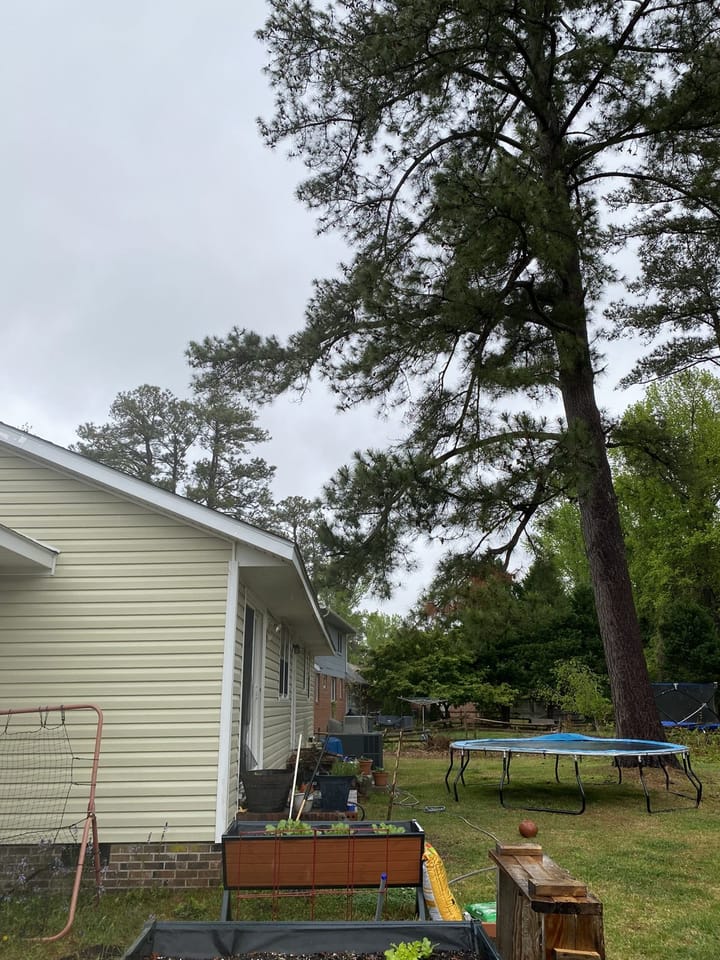
$3,000–$4,000 to $6,000–$8,000: why a 90 foot pine costs almost double an 80 foot pine
$1,300 to $6,000–$8,000 when the tree is close to the house
7 line items a real estimate itemizes — and a written quote before work starts
$1,500–$2,500 from a photo for a small pine — above that we come and look
$6,000–$15,000+ when the tree is already on the structure
Why our numbers differ: we price a crew-day, not a tree
You will see five different ranges on this page, and they are not five guesses at the same thing. We price what a job actually consumes: a crew for a day, plus the equipment that crew needs to finish it safely. Count those two and you have the number.
The hinge is the second day. A removal that finishes inside one crew-day prices one way. The same removal that bleeds four hours into a second morning does not cost a sixth more — it costs another mobilization, another day of lift time, and another day of three people's wages. That is the single biggest reason the same tree can carry two prices, and it is why we would rather look at it than guess from a photo.
Here is how the five coexist:
- $800 minimum. Not a tier — a floor. Getting a full crew and the equipment onto your property costs the same whether we then cut one limb or a whole pine, so there is nothing below it to sell.
- $1,500–$3,500 for most removals. One crew, one day, room to work. This is the band when nothing about the site is fighting us.
- $3,500–$6,000 large or hazardous. Still one day, but now it needs the lift — either because of the height or because a defect means the tree cannot be climbed. Machine time is the largest line on any removal.
- $6,000–$8,000 beside or over the house. The same tree as the row above, and often the same height and diameter. What changed is that nothing can be dropped: every piece comes down on a rope, and rigging is slow. This is the band where day two starts showing up.
- $6,000–$15,000+ emergency, tree already on the structure. Almost none of this is the tree. It is after-hours mobilization, a crane or a lift, taking a loaded trunk off a roof in pieces, working around the weather, and tarping the opening before we leave — and it is two days more often than one.
Read down that list and the price is not tracking the tree getting bigger. It is tracking options being taken away — somewhere to drop it, room for the machine, a trunk sound enough to climb, a day that ends when the light does. Every option removed is hours added, and past a certain point hours become a second day.
Which is why the number you get from us is a written quote before any work starts, against a scope we have walked.
3 jobs, with what each one came to
Real jobs, redacted — neighborhood or road at most, month and year only, no customer details. Under each figure is how it was arrived at: invoiced, quoted, or billed to an insurer.
| Job | Size & access | Price | What set it |
|---|---|---|---|
| Tree removal + stump grindingRichlands · September 2026 | ~60 ft oak, growing into a fenceTight — 8 ft side path to the backyard, worked from both yards | $2,800invoiced | Cut, hauled away and stump ground. Spider lift, Bobcat MT120 mini track loader and Carlton stump grinder. The 8 ft side path ruled out anything bigger, so the job ran from the owner’s yard and the neighbour’s. Invoiced and paid. |
| Tree removal + stump grindingOff Piney Green Rd, Jacksonville · September 2026 | ~75 ft oak, front yardOpen yard | $3,400invoiced | Cut down, hauled away and stump ground using the 90 ft spider lift. An open front yard is the cheap version of a tree this size — room to work and somewhere to put the pieces. Invoiced and paid. |
| Emergency storm removalCentral Jacksonville, near the Angry Ginger · September 2026 (on site Sep 3–4) | ~60 ft oak, failed limbs on the houseOver a structure | $6,965insurance-billed | Limbs lifted off the roof, a 20×20 ft emergency tarp over the opening the same visit, and four debris loads. The homeowner paid $0 out of pocket — we handled the entire claim and billed the insurer directly, where other quotes ran $5,000–$10,000 and wanted the homeowner to pay first and wait for reimbursement. Because the standing trunk was left badly compromised, the insurer also approved taking the rest of the tree; that depends on the policy and the adjuster, but we make the case when the remaining tree threatens the house. Billed and paid. |
Tree Service in Jacksonville, NC
Looking for local tree experts in Jacksonville? We provide professional tree care throughout Jacksonville, NC and surrounding communities. Visit our tree service in Jacksonville NC page for more details on the services we offer in your area.
Other Services We Offer
We also provide professional tree removal, tree trimming, stump grinding and emergency tree service services in Jacksonville, NC and surrounding areas.
Want to hear it from our customers first? Read all 27 Google reviews — what comes up most is the cleanup, the communication, and the fact that the quoted number holds.
Frequently Asked Questions
How much does tree removal cost in Jacksonville, NC?
Tree removal in Jacksonville, NC starts at an $800 minimum. Most removals run $1,500–$3,500. Large or hazardous trees run $3,500–$6,000, a tree beside or leaning over the house runs $6,000–$8,000, and exceptional jobs with tight access, severe hazards or complex rigging start at $10,000+. These are our own bands for our crew and equipment in Onslow County, not a national average.
What is the average cost to remove a large pine tree in NC?
Diameter decides it more than height, and there are three tiers. 70–80 feet tall, about 28–32 inches in diameter at breast height, open yard: $3,000–$4,000, and we do these quite frequently. about 90 feet tall, about 36–38 inches in diameter, behind the house with some room to work: about $6,000 with stump grinding included. 90–100 feet tall, leaning over the house with obstacles — a shed, a fence, a power line: $10,000+. Bring the middle size closer to the house and it sits in the $6,000–$8,000 band.
How much does it cost to remove a tree close to a house?
It depends on size once position has already ruled out dropping the tree. A small tree near the house is typically $1,300 including the stump. A mature tree near the house runs $2,000–$3,200. A tree hard against the house or leaning over it runs $6,000–$8,000, because every piece has to be rigged down over a roof. If the tree is already on the structure, that is emergency work and runs $6,000–$15,000+.
What should be included in a tree removal estimate?
Seven things, itemized, in writing before any work starts: mobilization and demobilization as its own line; equipment by the hour for the lift, crane and loader; crew labour broken out by role and hours rather than one lump; debris hauling counted and priced by the load; disposal fees separate from hauling; stump handling as its own line; and on insurance jobs the split between emergency mitigation and debris removal, because the tree-debris sublimit on a homeowner policy generally applies to the debris side and generally does not apply to the mitigation side.
Why does a 90 foot pine cost almost double an 80 foot pine?
Because past about 36 inches in diameter the job changes tools and trips. A 30 inch trunk can be cut with about $1,000 saw; past that we bring out a $2,500–$3,000 one. A 70 foot, 28 inch pine is roughly 6–7 logs at 8–10 feet and often one load on our single-axle log truck, while a 90 foot, 36–38 inch pine is 8–10 big pieces and the heavy bottom half needs a second run. There is more limb structure to haul, and most bucket trucks only reach 60–70 feet where we run a 90 feet lift.
Does insurance cover tree removal?
Insurance may cover removal if the tree caused damage to a structure. We bill your insurance directly and work with your adjuster, so you are not paying the whole job up front and waiting for reimbursement. Ask for the estimate split between emergency mitigation and debris removal — the tree-debris sublimit generally applies to the debris side and generally does not apply to the mitigation side. Where a standing trunk is left badly compromised, we make the case to the adjuster for removing the rest of the tree, though that depends on the policy and the adjuster.
Get a Fast Quote
Fast response. Fair pricing. No obligation.
Get a Written Quote Before Any Work Starts
We walk the site, price the crew-days and the equipment it actually needs, and put the number in writing. Free estimates in Jacksonville and surrounding areas.
📞 Call Now