Tree Removal in Jacksonville, NC
Safe, Insured Tree Removal — Free Estimates
Professional tree removal services in Jacksonville, NC. Safe, efficient, and fully insured. Call Godhans Tree Company for a free estimate.
Tree removal in Jacksonville, NC starts at an $800 minimum. Most removals run $1,500–$3,500, with large or hazardous trees at $3,500–$6,000. This is not an average — it is the same tree in two places. A pine of about 90 ft, 36–38 in behind the house with some room to work is about $6,000, stump grinding included. Put a pine of 90–100 ft leaning over the house with obstacles — a shed, a fence, a power line, so nothing can be dropped and every piece has to be sectioned and rigged out, and it is $10,000+. The tree barely changed — the obstacles did.
When Should You Remove a Tree?
How long does it take to remove a large tree?
Why We Have an $800 Minimum
Why Pine and Sweetgum Are the Most-Removed Trees in Jacksonville
85 to 90 feet is the usual cap on a Jacksonville pine — and height is not what prices it
Is your pine dying? The short version
The Third One: Bradford Pear
Sandy Ground, and the Crane We Put in a Yard
Wind, Lightning, and When Trees Actually Break
Removals for Builders and New Construction
Service Areas for Tree Removal
Taking a Pine Down Between Two Houses
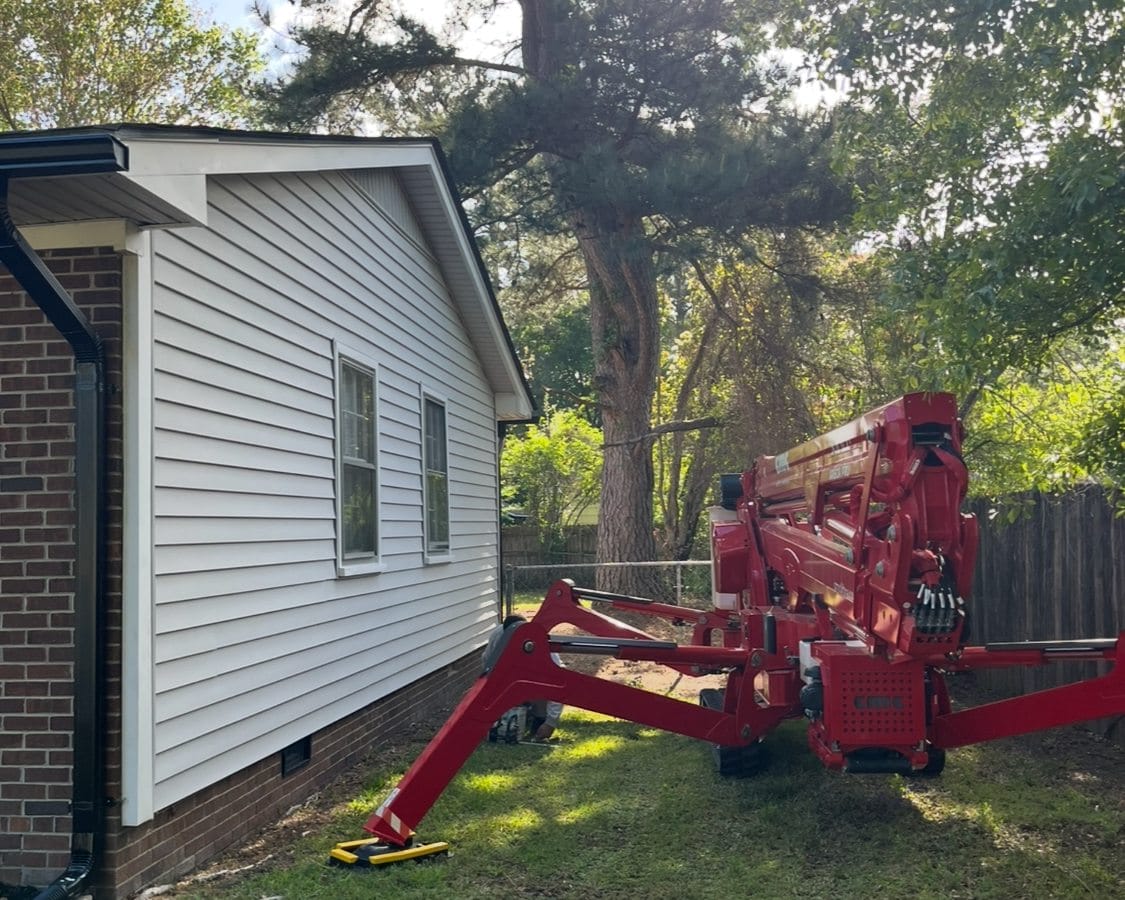
A tall loblolly with a house on either side and no room to drop it. The spider lift walks in on tracks, so there is no crane on the lawn and no ruts across the sandy ground — the two problems that otherwise decide how a job like this gets priced.
The trees nobody else would touch — Gene Circle, Jacksonville
Two removals at one Gene Circle address: a 105-foot tulip poplar eight feet from the house at $12,000–$13,000, and a 120-foot pine rigged out over a fence at $8,500.
Neither was about size. Both were about whether anyone could do them at all — safely, in the space available, without dropping a hundred feet of timber onto a house. Here's what set each number.
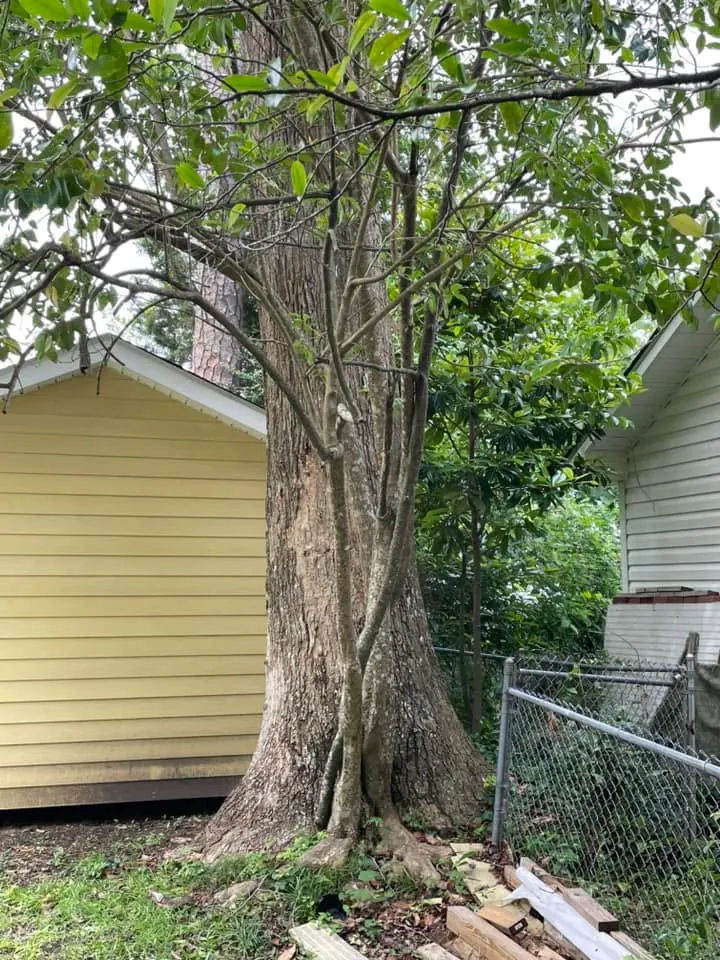
The bee tree — $12,000–$13,000
A 105-foot tulip poplar, dead-topped and rotting, eight feet from the client's house. A fence tight against one side, the neighbor's shed two feet beyond it, the client's own shed two feet behind the trunk. The working space was barely bigger than the tree.
Most companies would have guessed at the risk. We measured it. Using our IML-RESI resistograph — a calibrated instrument that drills a fine needle through a standing trunk and records the wood's density onto a strip, revealing cavities and rot invisible from the outside — we mapped the decay before anyone left the ground. We're the only company operating one in this area.
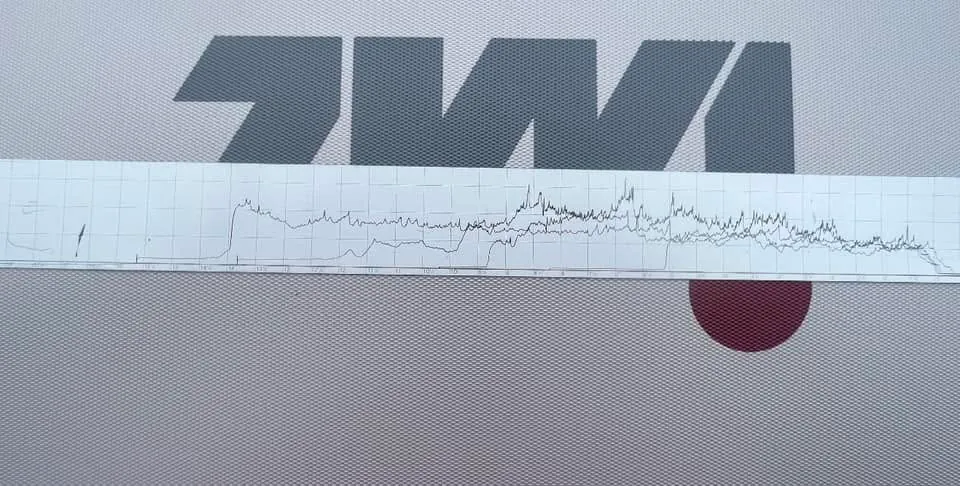
The reading was alarming: on a 56-inch trunk, the sound outer wood was down to six inches on the good side and four on the bad. The rest was shell.
Then, sixty feet up, we found the other problem: an estimated 30,000-bee hive living inside the trunk.
No crane could reach it. So we did it the hard way — negative-rigging the entire tree down by rope, by hand, in bee suits, in 95-degree heat. Four to five days. Not one piece touched the house.
Tulip poplar bark is part of why it took that long. It is smooth, with nothing for a rope to bite on, so a sling set around a cut log simply slides. We ended up cutting notches into the logs themselves to give the rigging rope something to hold — an extra operation on every single piece, sixty feet up, in bee suits.
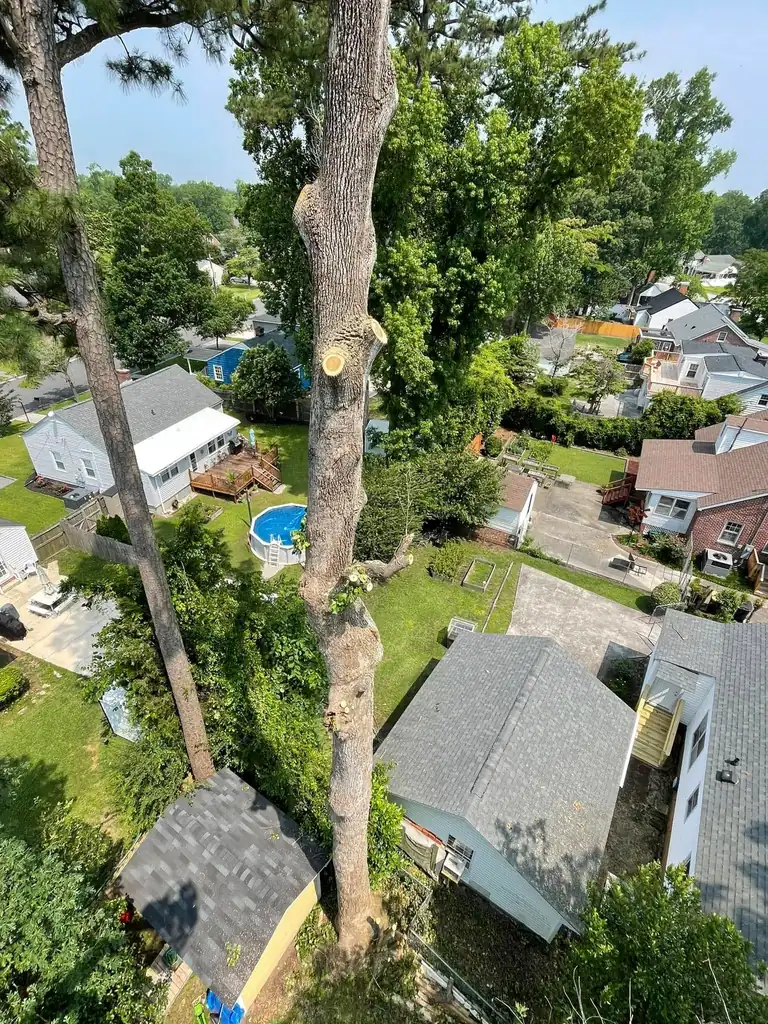
The tree in a box — $8,500
We came back for the second one: a 120-foot pine wedged behind a shed with less than a foot of clearance and fences on three sides. It was, functionally, standing in a box. No crane access. We rigged it down over the fence and picked the pieces up out of the neighbor's yard, section by section, by rope. A day and a half — under two days, start to finish.
The measurements are the part worth having, because they are what a price is actually built from. 120 feet tall. 28 inches across at the base, still 20 to 22 inches well up the stem — which is a lot of weight a long way off the ground. Four long limbs. Five separate rigging setups. One trailer of limbs, and logs cut at 10 to 12 feet because that was the longest piece that could be swung over the fence and landed without hitting anything.
Why these numbers matter to you
That same 120-foot pine in an open field is a one-day job at about $3,000–$4,000. Boxed in behind a shed with fences on three sides and no crane access, it ran $8,500 over two days — and it was worth every dollar, because the alternative was a company that couldn't do it dropping it on a house.
Our most complex removals start at $10,000 and go up from there — jobs with severe hazards, no equipment access, or rigging done entirely by hand. These are rare, but when they come, we're the crew that can do them safely, and we'll tell you exactly why the number is what it is before we start.
The tree doesn't set the price. The obstacles do.
A $6,500 red oak where the stump took longer than the tree
Central Jacksonville, near the government buildings. A large red oak, removed for $6,500 — and the removal is not the interesting part of the invoice. The stump is.

That stump measured about five feet wide before the grinder touched it. Grinding it out meant taking roughly nine feet across in total, because a stump that size does not end where the trunk does — it runs out into large surface roots that have to be chased and ground individually. On an oak that age those roots are the real job.

The stump alone took all day. That is the thing worth carrying into your own estimate: when we say the grinder is the bottleneck, this is what we mean. The oak came down and got hauled; the stump is what decided the schedule.
How We Know If a Tree Is Actually Rotten
We drill it and measure, because on this coast you cannot tell from the outside.
Coastal humidity makes internal decay a constant reality here rather than an occasional finding. In our experience in the local area, heartwood rot is the leading killer of hardwoods, and it works from the inside out. Alongside it we see dry rot, wet rot, and root diseases that attack the tree below grade where nothing is visible at all. That it is the leading killer here is our own tally from our own jobs and not a published finding; what is published, and linked below, is what the organisms behind it are and how they behave.

That one is worth a second look, because it is the case this whole section is about. A hardwood roughly a mile from the Atlantic, carrying heavy heartwood rot, and none of it visible until the saw was in it. We cut it down and removed it.

Two are worth knowing by name, and both are described by NC State Extension. Armillaria root rot announces itself if you know where to look: white fungal mycelial fans under the bark, rhizomorphs that look like black strings under the bark or around the base, and clusters of yellow-orange mushrooms near the tree. Biscogniauxia canker — still widely called Hypoxylon — is, in Extension's words, “opportunistic, attacking trees already weakened or stressed by abiotic factors or other pests”; around here that usually means drought or construction disturbance around the root zone.
The cruel part is that none of this has to show. A trunk can be hollow while the bark over it looks perfect.
That's why we stopped guessing. The resistograph measures drilling resistance through the wood, so what we hand you is a density reading rather than an opinion. It condemns trees that look fine from the driveway — and just as often it does the opposite, and saves the solid 100-year-old oak that's the centerpiece of a yard and needs nothing but annual maintenance.
Sources
- NC State Extension Plant Toolbox — Pyrus calleryana (Bradford pear)Weak crotches that break with age, wind and ice; invasive in North Carolina; native alternatives worth planting instead.
- NC State Extension Forestry — NC Bradford Pear BountyA free native tree in exchange for a Bradford pear you remove, up to five, run with the NC Forest Service, NC Urban Forest Council and NC Wildlife Federation.
- NC State Extension — Pine Bark BeetlesKelly Oten, NC State University. The pitch-tube description quoted above, and southern pine beetle as “the worst pest of southern forests” against Ips engravers as “secondary pests”. The two-year wave pattern, the “many small holes” sign and the sawdust at the base are our own observations — Extension attributes sawdust-filled galleries specifically to the black turpentine beetle and gives no outbreak periodicity.
- NC State Extension — Common Disease Pests of Oak in North CarolinaThe Armillaria root rot signs quoted above — white mycelial fans, black string-like rhizomorphs, clustered yellow-orange mushrooms — and Biscogniauxia (Hypoxylon) canker as “opportunistic, attacking trees already weakened or stressed.” What we say about how often we find heartwood rot here is our own experience, not Extension’s.
Frequently Asked Questions
How much does tree removal cost in Jacksonville NC?
Removals start at an $800 minimum. Most run $1,500–$3,500; large or hazardous trees run $3,500–$6,000, and exceptional jobs — tight access, severe hazards, complex rigging — start at $10,000 and go up. We provide free estimates to give you an exact price.
Do I need a permit to remove a tree in Jacksonville NC?
Permit requirements can vary depending on location and tree type. We can help guide you through any local requirements if needed.
Read the full NC tree removal permit guide →How long does tree removal take?
It depends on size, and on whether you are grinding the stump. A small tree in an open yard is about 3 hours including cleanup. A single tree with no grinding is often a same-day job whatever its size. A big pine — 80 to 90 feet, two and a half to three feet through — runs 1 to 1.5 days. A massive pine, or one hard against a structure where every piece has to be rigged, runs 1.5 to 2 days. The stump is usually what pushes a job into a second day: an ordinary one is about an hour and a half of grinding, a big one 3 to 4 hours, and on the large stumps there is often another half-day after that to scrape up and haul the grindings.
Is tree removal dangerous?
Yes, tree removal can be hazardous without proper equipment and experience. That's why it's best handled by trained professionals.
Is a free estimate the same as a tree inspection?
No, and the difference is worth knowing. If you are considering work — a removal, a trim, a stump — we come out, look at it and price it for free, with no obligation. A standalone arborist health and risk assessment is a different service and costs $300–$500, covering two or three trees and stretching to about ten on one visit. You are paying for a considered written opinion on whether your trees are safe and what they need, including the possibility that the answer is to leave them alone.
What a paid assessment includes, and what testing costs →Veteran-Owned, Family-Operated — Serving Onslow County Since 2013
- Veteran-owned & disabled-veteran-owned
- Family-operated — you talk to the people doing the work
- Serving Onslow County since 2013 — 3,500+ jobs
- $2M general liability + workers' comp; every machine individually insured
- Godhans LLC — registered & active with the NC Secretary of State (SoSID 1961439)
$2M general liability and workers' comp on every job — and every machine, including the spider lift, is individually insured. If a contractor's equipment isn't on the policy and it damages your home, you hold the bill. Ours is covered.
Meet Michael and James — the brothers who own the company and run the crew.
On the job in Onslow County


Tree Service in Jacksonville, NC
Looking for local tree experts in Jacksonville? We provide professional tree care throughout Jacksonville, NC and surrounding communities. Visit our tree service in Jacksonville NC page for more details on the services we offer in your area.
Other Services We Offer
We also provide professional tree trimming, stump grinding and emergency tree service services in Jacksonville, NC and surrounding areas.
Guides & Pricing
More detail on what removals cost and how we handle the hard ones:
- How much tree removal costs in North CarolinaFull price ranges, what drives them, and why the same tree can cost double.
- Removing a tree close to your houseHow we take down trees leaning over a roof without dropping anything on it.
- When it is the neighbor's treeWho can cut what, who pays when one falls, and whether we will work from next door — cited to North Carolina sources.
- Spider lift tree removal for backyards with no truck accessFits a standard 4-foot gate, 90 ft platform with about 95–96 ft of working reach, and doesn't tear up the lawn.
Want to hear it from our customers first? Read all 27 Google reviews — what comes up most is the cleanup, the communication, and the fact that the quoted number holds.
Get a Fast Quote
Fast response. Fair pricing. No obligation.
Get a Free Tree Removal Estimate Today
If you need professional tree removal in Jacksonville, NC, we're here to help. Contact us today for a fast, free estimate and let our team handle the job safely and efficiently.
📞 Call Now